Saturday, July 21, 2012
Of martyrs and media stars
George Zimmerman and James Holmes would seem to have very little in common.
Zimmerman describes himself as a man versus "the gun" (in a Sean Hannity/Fox TV interview).
Holmes has yet to describe his view of self in light of recent gruesome events, but wait not too long.
It may be coming.
Which brings me to questions redundant, never fully answered.
How does media, whether manipulated (or prodded) by victim's interests as well as particular so-called perpetrator "rights" serve the (best) public interest in such cases?
To inform factually is a given, however, does media, by exposing every angle and facet of a crime while the investigation and prosecution is in progress, truly serve the public?
How much information is too much?
In particular, when does a (self-confessed) perpetrator of violent crime, involving death and/or debilitation, deserve to be heard?
The Zimmerman justification is (uniquely) more or less: "He's been convicted in the press already by a liberal-inspired agenda that used the parents of the victim to elicit an emotional rush to judgement, so let George speak."
He has.
A sampling:
""I feel that it was all God's plan, and for me to second guess it or judge it," (shook his head).
The Holmes justification might be: "He murdered 12 people (58 injured) in a premeditated rampage, but he's very bright, so let's hear what he has to say."
In other words, the upcoming (recurring) refrain might be, "the mentally ill are our problem - as collective humanity; shame on us . . . and let's hear from this pitiful [expletives deleted].
So far (thankfully) the victim's voices have been the loudest and clearest.
Bottomline:
How well do media (or any of us) actually listen (well) to the voices of the dead - as well as those now separated from their loved ones?
Shouldn't we, can't we do better?
But what is liberty without wisdom, and without virtue? It is the greatest of all possible evils; for it is folly, vice, and madness, without tuition or restraint." ~Edmund Burke
Friday, July 6, 2012
Native Wisdom
"So live your life that the fear of death can never enter your heart. Trouble no one about their religion; respect others in their view, and demand that they respect yours.
Love your life, perfect your life, beautify all things in your life.
Seek to make your life long and its purpose in the service of your people.
Prepare a noble death song for the day when you go over the great divide.
Always give a word or a sign of salute when meeting or passing a friend, even a stranger, when in a lonely place.
Show respect to all people and grovel to none.
When you arise in the morning give thanks for the food and for the joy of living. If you see no reason for giving thanks, the fault lies only in yourself.
Abuse no one and no thing, for abuse turns the wise ones to fools and robs the spirit of its vision.
When it comes your time to die, be not like those whose hearts are filled with the fear of death, so that when their time comes they weep and pray for a little more time to live their lives over again in a different way.
Sing your death song and die like a hero going home."
~Chief Tecumseh (allegedly composed by him, but also ascribed to Wabasha, Sitting Bull, Crazy Horse and Wovoka) [and as recently quoted in the movie, "Act of Valor"]
Tecumseh
Saturday, June 23, 2012
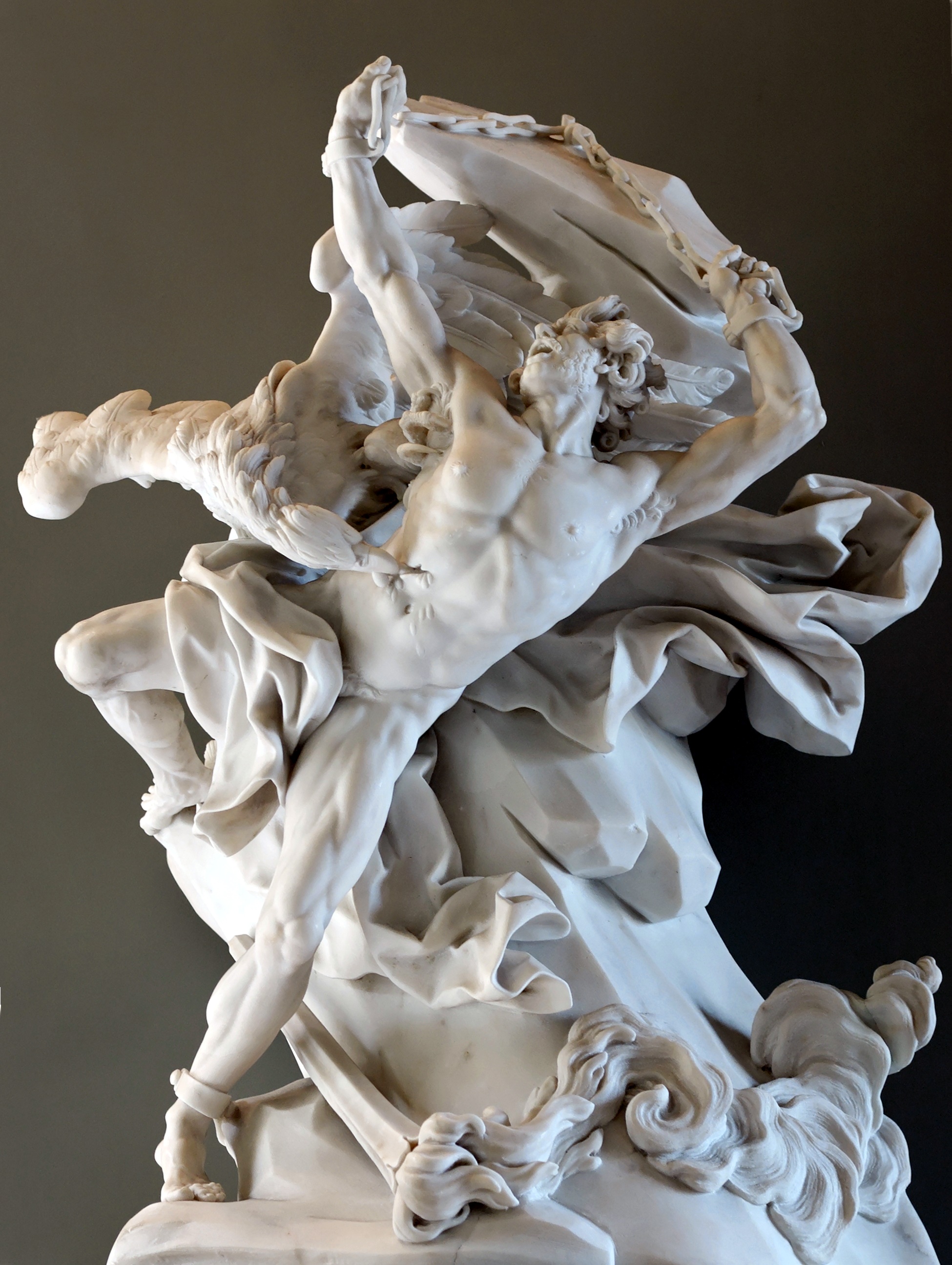
Greek gods and ends
With so many Greek (and Greece) references bombarding the senses lately (the titanic "Alien" prequel epic Prometheus, for one; not to mention the focus of European economic ruin and gallant efforts, also) I thought I'd at least come on board with something on a subject near my heart and of some relevance to this blog's continuing theme of divine/human juxtapositions.
No matter what the ruling this week on the Great American Healthcare Boondoggle, the debate (and spin) will continue.
A 2006 article from Businessweek read over this morning got me considering some of the other sides of why this is so.
So much of medicine (politics, etc.), even today, remains guesswork.
That said, Dr. David Eddy (featured in aforementioned article) today continues to promote solutions through computer modeling as well as prudence and due diligence before any (particularly such high and mighty) policy recommendations.
Founded in 1992, his Archimedes, Inc. began as a consultancy for Kaiser Permanente.
A watershed for Archimedes came in 2007 when the Robert Wood Johnson Foundation awarded it a $15.6M grant to make the power of the Archimedes Model "accessible to a wider range [of] health policy and healthcare decision makers, more rapidly and less expensively that had been possible in the past."
It would seem to behoove we the voting populace of citizens everywhere to realize that *many* politicians (aka titanic tricksters) have seen us, more or less, as their very own private guinea pigs.
Armed with such knowledge, does it not make some sense, therefore, that we might simply be stuck here (on terra firma with Gaia), forever, striving to embody the elusive, yet commonsensical Hippocratic mantra of "Physician (and patient) heal thyself"?
No matter what the ruling this week on the Great American Healthcare Boondoggle, the debate (and spin) will continue.
A 2006 article from Businessweek read over this morning got me considering some of the other sides of why this is so.
So much of medicine (politics, etc.), even today, remains guesswork.
That said, Dr. David Eddy (featured in aforementioned article) today continues to promote solutions through computer modeling as well as prudence and due diligence before any (particularly such high and mighty) policy recommendations.
Founded in 1992, his Archimedes, Inc. began as a consultancy for Kaiser Permanente.
A watershed for Archimedes came in 2007 when the Robert Wood Johnson Foundation awarded it a $15.6M grant to make the power of the Archimedes Model "accessible to a wider range [of] health policy and healthcare decision makers, more rapidly and less expensively that had been possible in the past."
It would seem to behoove we the voting populace of citizens everywhere to realize that *many* politicians (aka titanic tricksters) have seen us, more or less, as their very own private guinea pigs.
Armed with such knowledge, does it not make some sense, therefore, that we might simply be stuck here (on terra firma with Gaia), forever, striving to embody the elusive, yet commonsensical Hippocratic mantra of "Physician (and patient) heal thyself"?
Prometheus bound: "May I at least have a nice Chianti to go with that?"
Monday, May 21, 2012
Our Indispensable Moon
Caught a documentary on The Science Channel early the other morning (first broadcast back in 2011 on BBC Two).
Space scientist and "lunar fanatic" Dr Maggie Aderin-Pocock explores our intimate relationship with the Moon. Besides orchestrating the tides, the moon dictates the length of a day, the rhythm of the seasons and the very stability of our planet.
Yet the Moon is always on the move. In the past it was closer to Earth and in the future it'll be farther away. That it is now perfectly placed to sustain life is pure luck, a cosmic coincidence. Using computer graphics to summon up great tides and set the Earth spinning on its side, Maggie Aderin-Pocock implores us to look at the Moon afresh: to see it not as an inert rock, but as a key player in the story of our planet, past, present and future. Toward that end, the discovery of water on the moon is highlighted to powerful effect.
An essay by Bernard Foing, Executive Director of the International Lunar Exploration Working Group, in Astrobiology Magazine online sums up the Moon's place (so far) within the human universe fairly succinctly:
Space scientist and "lunar fanatic" Dr Maggie Aderin-Pocock explores our intimate relationship with the Moon. Besides orchestrating the tides, the moon dictates the length of a day, the rhythm of the seasons and the very stability of our planet.
Yet the Moon is always on the move. In the past it was closer to Earth and in the future it'll be farther away. That it is now perfectly placed to sustain life is pure luck, a cosmic coincidence. Using computer graphics to summon up great tides and set the Earth spinning on its side, Maggie Aderin-Pocock implores us to look at the Moon afresh: to see it not as an inert rock, but as a key player in the story of our planet, past, present and future. Toward that end, the discovery of water on the moon is highlighted to powerful effect.
Another documentary (broadcast in 1999 on Discovery) entitled "If We Had No Moon,"
though obviously less up to date scientifically, delved deep into the "indispensable quality" theme.
An essay by Bernard Foing, Executive Director of the International Lunar Exploration Working Group, in Astrobiology Magazine online sums up the Moon's place (so far) within the human universe fairly succinctly:
"Finally, the Moon had a key role in the emergence of science, and in our understanding of our place in the universe. We saw the repetition of the phenomena of lunar phases, and we observed solar and lunar eclipses. These were big challenges to our understanding of nature, and a few astronomers were put to death because they weren’t able to predict the eclipses. This challenged us to develop accurate predictions for the motion of the sun and the motion of the Moon.
Studying the Moon helped us determine distances in the solar system and the size of celestial objects. By studying lunar phases, for example, people were able to determine how far the Moon is from the Earth, the size of the Earth, and our distance from the sun. More recently, the Moon was the terrain where the space race took place between two political systems, allowing for great technical and scientific achievements. The Moon has inspired humankind to learn how to travel to space, and to bring life beyond Earth’s cradle."
Sunday, March 18, 2012
When they came for me
In Sudan, security forces have confiscated a third consecutive issue of the country's Communist Party newspaper, Al-Midan, reportedly for "ignoring a warning to avoid writing about the killing of a girl by police which sparked protests," according to the editor.
Though Sudan's constitution guarantees freedom of the press, such incidents have increased, coinciding with the secession of South Sudan in July 2011.
In total, three newspapers critical of the government since the start of the year have had publication suspended, although one has since resumed production.
Of note, also, Sudan has [somehow] avoided a popular uprising such as those seen in Tunisia, Egypt and elsewhere.
However, small protests in Khartoum and other cities over rising food prices and other issues have apparently been worrisome, particularly for international outlaw, Lieutenant General Omar Hassan Ahmad Al-Bashir, President of Sudan.
Though Sudan's constitution guarantees freedom of the press, such incidents have increased, coinciding with the secession of South Sudan in July 2011.
In total, three newspapers critical of the government since the start of the year have had publication suspended, although one has since resumed production.
Of note, also, Sudan has [somehow] avoided a popular uprising such as those seen in Tunisia, Egypt and elsewhere.
However, small protests in Khartoum and other cities over rising food prices and other issues have apparently been worrisome, particularly for international outlaw, Lieutenant General Omar Hassan Ahmad Al-Bashir, President of Sudan.
Friday, March 9, 2012
Gulag Ethiopia
Well regarded and widely read, Professor Alemayehu G. Mariam, who teaches political science at California State University, San Bernardino has been writing weekly on the plight of his countrymen and their particular regional issues for the last several years.
As he writes:
Meanwhile, the country as a whole finds itself (also) in the grips of yet more drought and consequent famine.
And, in any case, the forecasts of various forecasters, whether official, professional or anonymous remain, ultimately, bleak.
There is, however, ever, music . . .
As he writes:
In August 2009, I spoke at a town hall meeting organized by “Gasha for Ethiopia”, a civic organization, on the importance of remembering Ethiopian political prisoners:Further and more recently:
In the end, we will remember not the words of our enemies, but the silence of our friends,” said Dr. Martin Luther King… Nothing is more important and uplifting to political prisoners than knowledge of the fact that they are not forgotten, abandoned and forsaken by the outside world. Remembrance gatherings at town hall meetings such as this one serve to remind all of us who live in freedom the divine blessings of liberty and the unimaginable suffering of those trapped in the darkness of dictatorship.
Andualem Aragie and countless political prisoners in Ethiopia reamin trapped in the darkness of dictatorship. They have been beaten down and brought to their knees. We cannot hear their whimpers of pain and desperation. Few, other than their tormentors, will be able to see their mangled bodies. Because they have no voice, we must be their voices and speak on their behalf. Because they are walled in behind filthy and subhuman prison institutions, we must unflaggingly remind the world of their suffering. We must all labor for the cause of Ethiopian political prisoners not because it is easy or fashionable, but because it is ethical, honorable, right and just. In the end, what will make the difference for the future of Ethiopia is not the brutality, barbarity, bestiality and inhumanity of its corrupt dictators, but the humanity, dignity, adaptability, audacity, empathy and compassion of decent Ethiopians for their wrongfully imprisoned compatriots. That is why we must join hands and work tirelessly to free all political prisoners held in Ethiopia’s public and secret gulags. “Let the oppressed go free, and remove the chains that bind people.”
The “Gulag” prison system in the old Soviet Union was infamous for warehousing and persecuting dissidents and opponetns. The gulags were used effectively to weed out and neutralize opposition to the Soviet state. They were the quintessential tools of Soviet state terrorism. Some called them “meat-grinders” because of the extremely harsh and inhumane conditions. Torture, physical abuse by prison guards, solitary confinement, inadequate food rations and officially instigated inmate-on-inmate violence were the hallmarks of the gulags.
Ethiopia’s prison system today are reminiscent of the Soviet gulags in their abuse and mistreatment of political and other prisoners. Let the facts speak for themselves -->>>
Meanwhile, the country as a whole finds itself (also) in the grips of yet more drought and consequent famine.
And, in any case, the forecasts of various forecasters, whether official, professional or anonymous remain, ultimately, bleak.
There is, however, ever, music . . .
Thursday, February 23, 2012
Somewhere Syria
In Syria, as elsewhere, Arab Spring continues to bleed.
Will "Democracy" truly save the day?
A "Friends of Syria" parlay hopes so:
More . . .
Will "Democracy" truly save the day?
A "Friends of Syria" parlay hopes so:
[U.S. Secretary of State Hillary] Clinton leaves London for a visit to Tunisia to participate in the meetings. The State Department said the meeting was "part of our ongoing efforts with our friends, allies, and the Syrian opposition to crystallize next steps to halt the slaughter of the Syrian people and pursue a transition to democracy in Syria."
A report from the independent international commission of inquiry on Syria found the government has "manifestly failed" to protect its own people.
"The present situation risks further radicalizing the population, deepening inter-communal tensions and eroding the fabric of society," the panel found.
The panel, in a 72-page report published Thursday (2/23), said there was a "reliable body of evidence" to suggest officials at the "highest level of government" were responsible for crimes against humanity in Syria.
More . . .
Subscribe to:
Posts (Atom)